The term 'loop engineering' popped up everywhere, the big labs released cheaper standard models, and access to the strongest models suddenly became a geopolitical issue. On top of that, creators took concrete steps to reclaim control over their work. An edition about AI that works independently, deliberate choices, and the human who keeps final control.

:focal())
Every two weeks on the Xylos blog, we bring you a sharp and honest overview of what's really moving in the world of generative AI, with the context you need. The foundation remains the biweekly LinkedIn overview by Tom Van 't veld, Learning Innovator at OASE (powered by Xylos). Tom follows AI developments closely, and we translate his observations into what they concretely mean for organizations and the people working in them. Welcome to edition seven.
EDITION 7 • JULY 6, 2026
Below are the stories from the past two weeks that matter most for your organization.
Loop engineering: between real technique and the token bill
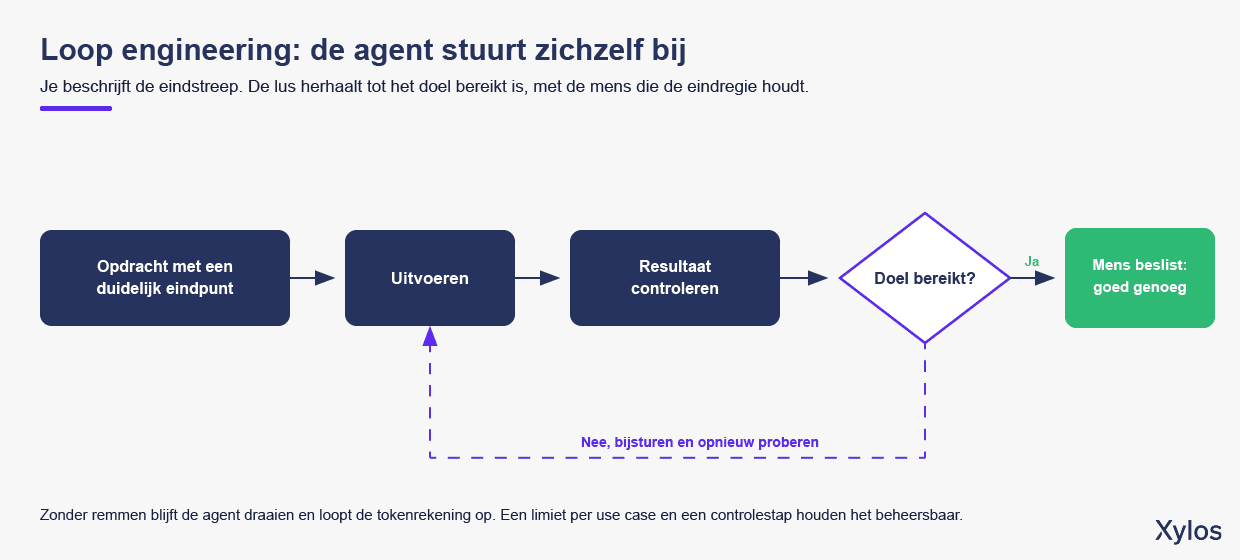
'Loop engineering' is the term you saw popping up everywhere in recent weeks. The idea is simple: instead of typing separate prompts, you let an AI agent run in a loop that corrects itself. Try, check the result, try again, until a goal is reached. Boris Cherny, the man behind Claude Code, summed it up as 'I don't prompt anymore, I write loops.' Anyone who has already worked with agentic tools recognizes it immediately. It comes down to giving a sharp instruction that asks the model to check its own work.
Still, there's more to it than a better prompt. The difference lies in memory and control. A prompt runs once, a loop remembers what went wrong and tries to do better next time. The real work lies in two things: sharply defining when something is done, and building in brakes. Without those brakes, an agent keeps running, keeps consuming tokens, and racks up a substantial bill. Anthropic itself admits that this kind of multi-step setup can quickly swallow fifteen times more tokens than a regular conversation. Choosing the right model per task also becomes decisive here.
For organizations, there's a principle in this topic that reaches further than the buzzword. The technique is real, the cost is just as real, and the gain lies in deliberate choices. From now on, you describe the finish line instead of every step, and you stay in the loop as a human to decide when it's good enough. Build agentic workflows with a clear endpoint, a consumption limit per use case, and a human check-in step. That way you capture the speed without the token bill becoming a surprise. Our AI experts help you make those choices before you roll out broadly.
Cheaper standard models, but not every model fits every task
The model makers are competing with faster and cheaper versions. Anthropic released Claude Sonnet 5, a model that comes close to the pricier Opus 4.8 at 40 to 60 percent lower cost and immediately becomes the standard for free and Pro users. OpenAI did something similar, setting GPT-5.5 Instant as the new standard for all ChatGPT users, with fewer hallucinations and more concise answers.
Looks good on paper, though practice shows the nuance. When Tom himself tried to build a complex interface, Sonnet 5 got stuck, while the pricier Opus solved the task on the first try. For more standard tasks in the Claude app, the cheaper model works just fine. Meanwhile, Google keeps pushing Gemini further from chatbot toward something that actually acts on your screen. Gemini 3.5 Flash now has computer use built in, letting an agent view screens itself and click and type, at about a third of the token cost of GPT-5.5.
On top of that, Gemini got a series of smaller features for the daily workflow. It can now take notes during your Google Meet conversations, and meanwhile also in Zoom and Teams, and neatly puts the decisions and action items into a document. Handy, though the question here too remains who you give that access to and where the data ends up.
The lesson for organizations is that the cheapest model is rarely the best answer for every task. A light summary needs a different model than complex reasoning or sensitive code. Whoever deliberately chooses which model does the task per use case gains quality and keeps costs in check. Set that trade-off down in clear guidelines, so employees know when to reach for a heavier model and when the lighter one is enough.
Access to top models becomes a strategic issue
The main focus of recent weeks was on governments helping determine who gets to use the strongest models. OpenAI initially had to get its new GPT-5.6 approved customer by customer by the US government, which meant only around twenty screened companies got access for the time being while European customers had to wait. Shortly after, things moved the other way: the US government lifted the export restrictions on Mythos 5 and Fable 5 again, after which Anthropic started restoring foreign access with extra safety measures.
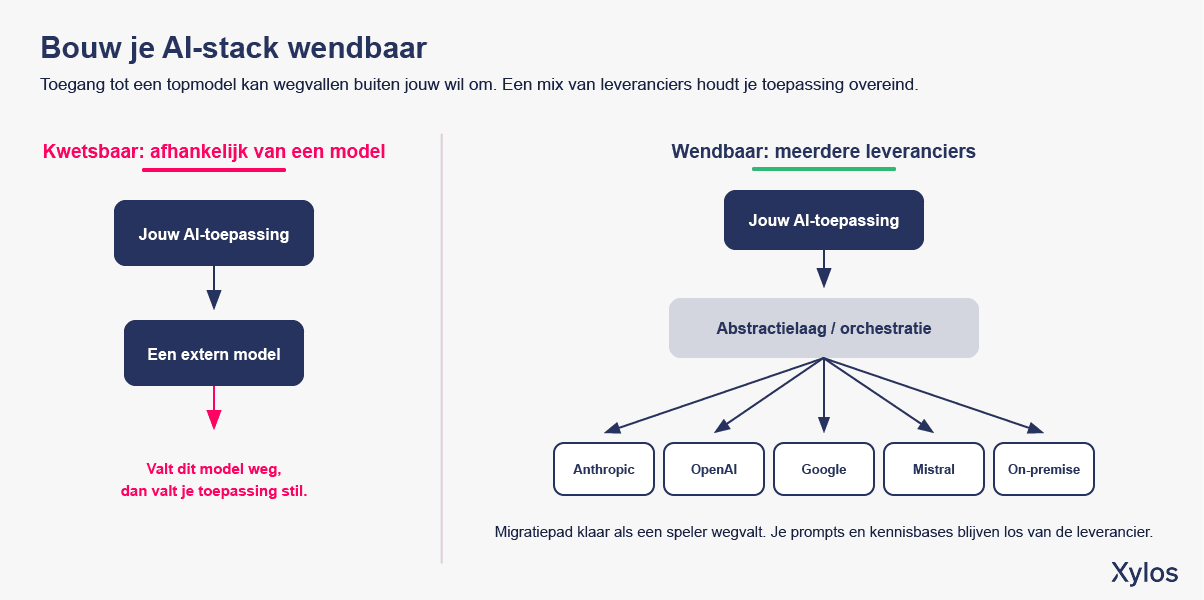
At the same time, tensions between Anthropic and China kept rising. Anthropic accuses operators of Alibaba's Qwen lab of running roughly 25,000 fake accounts to hold almost 29 million conversations with Claude, in order to copy its strongest capabilities. Alibaba, in turn, banned its employees from using Claude Code. The big players also repositioned themselves. Microsoft announced Frontier Co., a 6,000-person unit meant to help customers adopt AI, while Meta and Amazon said they want to loosen their dependence on a single model provider.
For Belgian organizations, there's a principle here that weighs heavier than the specific model. Access to top models is no longer just a commercial choice, it's increasingly shaped by geopolitics. VRT expert Tim Verheyden draws the same lesson: AI and geopolitics have become intertwined, and Europe would do well to become less dependent on a single vendor. The right reflex is to actively avoid vendor lock-in. Build your AI stack flexible enough to switch to a different model, and keep critical processes built around a well-considered mix of vendors, with a clear migration path in case one player falls away.
AI is reshaping jobs, and humans remain the amplifier
The impact on jobs became very concrete these past weeks. Oracle cut about 21,000 jobs over the past year and explicitly names AI as a factor. Ford did the opposite and brought back hundreds of experienced engineers after its AI quality control fell short. The company then finished at the top of a major quality ranking for the first time since 2010. The example that sticks the most comes from IKEA: it retrained around 8,500 call center employees into remote interior advisors instead of laying them off, after its AI assistant 'Billie' took over almost half of the simple questions.
At the same time, the cost question keeps coming back. Gartner warns that AI programming could become more expensive than the average developer salary by 2028, mainly due to rising token consumption. A conversation about the value of human contact in sales offers a reassuring picture: AI works mainly as an amplifier of the employee, as long as a human keeps final control. Messages drafted by AI but proofread by a human get 25 to 40 percent more response according to Linqed, while fully automated sequences are quickly recognized as generic.
The message for employers is twofold. AI takes over tasks, and precisely because of that, the ability to steer and judge AI becomes a basic competency at every level. Invest in reskilling instead of just tools, and make sure employees learn to prompt, evaluate and read critically. That aligns with what Tom and his colleagues at OASE and Xylos Learning build every day: learning programs that make people stronger and grow along with the incoming tooling.
Creators are reclaiming control over their work
A remarkable number of creators took a concrete step this week to reclaim control. Cate Blanchett launched a free registry at the European Parliament that lets artists use color codes to specify to what extent their face, voice or movements may be used by AI, backed by names like Tom Hanks and Emma Thompson. Dutch publishers and authors are building agreements on how their work may be used through their own book pact. And streaming service Tidal is the first major player to stop paying out royalties for fully AI-generated music.
What these three steps have in common is that asking for permission is slowly becoming concrete. Where the conversation long stayed at the level of principles, registries, agreements and payment rules are now emerging that define what's allowed and what isn't.
For organizations, this touches directly on your own AI output and your brand. The same question of provenance and consent will soon reach your content too. Set agreements today already on labeling AI-generated material and on which sources your models are allowed to use. That builds trust with customers and employees, and prevents surprises as copyright rules tighten further.
The downside of too much AI: quality, privacy and consumption
Companies leaning heavily on AI are now feeling the downside. The now-familiar 'workslop,' low-quality output that erodes trust and costs colleagues time to fix errors, is showing up more often. Researchers also point to 'AI brain fry' among some heavy users, caused by constantly checking AI answers.
Signals around data and privacy also kept piling up. At Meta, internal keystrokes, screen recordings and even staff evaluations that the company collected to train models leaked, after which the program was shut down. As of July 8, Anthropic will ask users to verify their identity with a live selfie and an ID document, to make sure no minors are chatting along, and says it won't use those images for training. Finally, the physical cost became tangible: during the recent heatwave, large data centers turned out to be warming up their surroundings too, with cooling already swallowing about 40 percent of their energy. Cambridge researchers estimate that effect could affect more than 340 million people.
The lesson is that more AI doesn't automatically mean more value. Without governance and human review, output erodes trust and knowledge, and the risk grows that company data leaves the organization through consumer tools. A workable answer combines technology and awareness: clear AI guidelines, an officially supported platform so the need for shadow tools disappears, and an ongoing training program that guards the line of what you entrust to an AI assistant. Our cybersecurity and learning teams often work together at that intersection.
We'll be back in two weeks with the next edition.
About Tom Van 't veld
Tom has worked for Xylos for years, where he started as a Microsoft Office trainer and grew into the driving force behind innovative learning concepts. He co-founded OASE, Xylos's online learning platform, and PlayForward, Xylos's new gamified learning brand. He also developed, among other things, the Digital Coach concept, a Microsoft Teams Escape Room app and the mAindset game, which helps employees learn to prompt AI in a playful way. As Learning Innovator, his focus in recent years has increasingly turned to what AI means for the way we learn and work. Want to respond or chat further? Find him on LinkedIn.