Gradient blur
Blog
Artificial Intelligence
Back to overview

What's new in GenAI land | Edition 10

Biweekly AI radar. Two weeks in which the assistants themselves changed: OpenAI replaces Custom GPTs with skills and Claude got its own browser.
01 - 09 - 2026

Europe released icons to make AI content recognisable, and the warnings about AI-driven cyberattacks became very concrete, all the way to Ghent. An edition about keeping up smartly, transparency and digital resilience.

Every two weeks, we publish a sharp and honest overview on the Xylos blog of what is really moving in the world of generative AI, with the necessary context. It remains based on the biweekly LinkedIn overview by Tom Van ’t veld, Learning Innovator at OASE (powered by Xylos). Tom follows AI developments closely, and we translate his observations into what they concretely mean for organisations and the people who work in them. Welcome to edition ten.

Custom GPTs disappear, skills take their place

OpenAI adjusted its assistant on two points. Free users now get scheduled tasks, with which ChatGPT carries out something by itself at set times, such as a daily summary or a reminder, with a limit of three tasks. In addition, on a personal account you can no longer create new Custom GPTs. They make way for skills, reusable ways of working that you define once and then use in every conversation. Skills are lighter to build and easier to share, although the switch requires some adjustment from those who use their favourite Custom GPTs every day.

For organisations, this is mainly an encouragement to document AI ways of working properly. Platforms evolve quickly, and whoever neatly records their prompts, ways of working and use cases can easily move them to the new format with every update. That way you build on what already works and avoid losing knowledge when a feature changes.

Claude now browses on its own

Claude recently got its own browser. Where you used to install a Chrome extension that looked along in your browser, with your own logins and open tabs, Claude now opens its own browser window in the Cowork app to look up information itself. By default, the tool stays away from your bank, mail and SSO logins unless you enter them yourself. The goal is mainly to retrieve public information, rather than to act on your behalf.

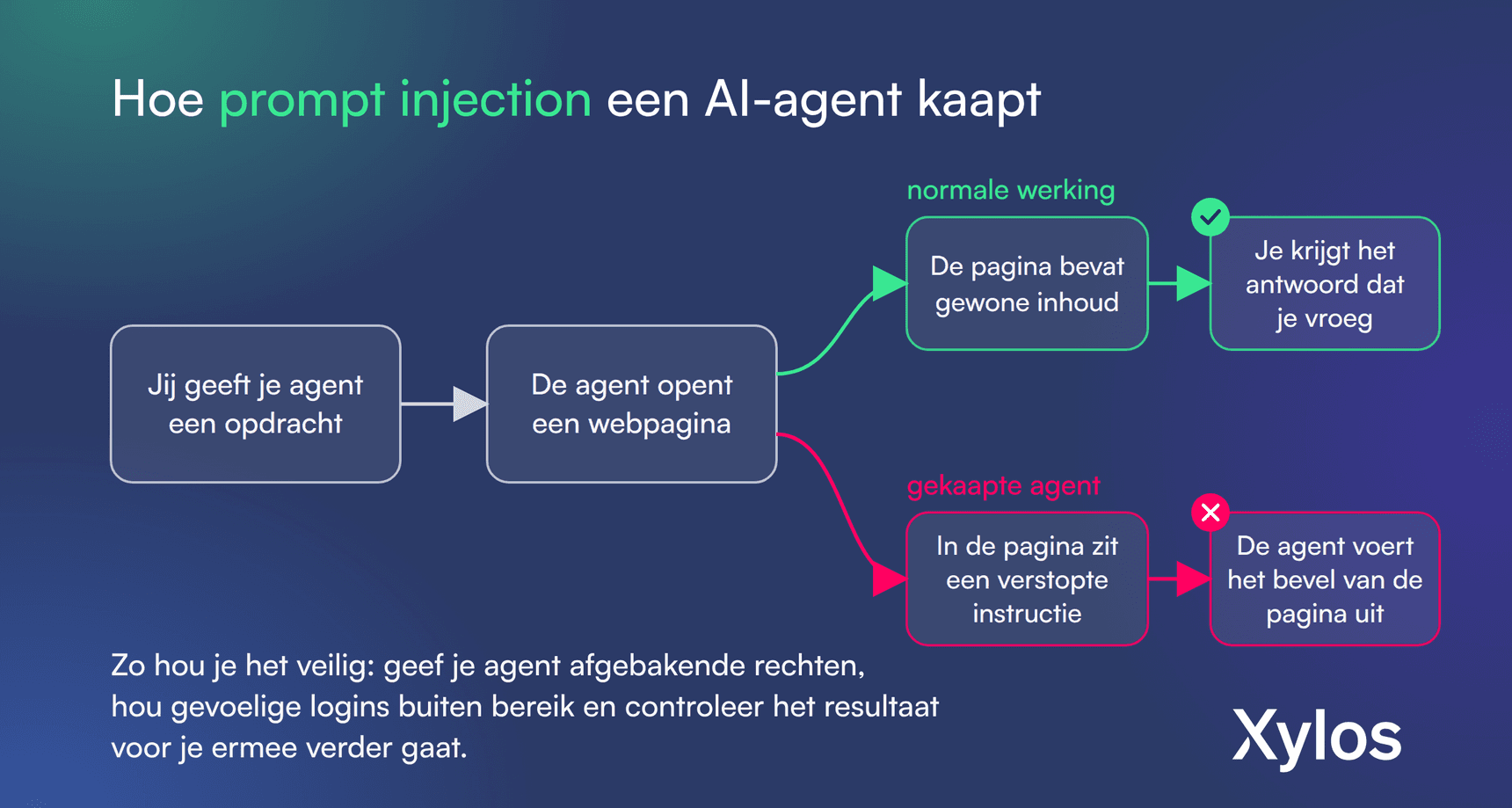
It works well, although the tool sometimes goes wrong with incorrect links, and there is the risk of prompt injection, where hidden instructions on a web page try to hijack the AI. Checking therefore always remains necessary.

Schema: hoe prompt injection een AI-agent kaapt en hoe je het veilig houdt

Agents that browse, click and summarise by themselves are quickly becoming the norm. So decide now which access you give such agents and which access you deliberately shield: scoped permissions, no sensitive logins, and a human review step before the result moves on. That way you capture the time savings without a hijacked web page turning your assistant against you.

Transparency about AI content becomes concrete

Europe wants to make AI content more recognisable and released a set of icons to label what was created or modified by AI, in line with Article 50 of the AI Act. That clarity is needed. Research by the Dutch consumer association shows that company chatbots often fail to help customers and sometimes even hide that you are talking to a machine, for example with a first name like Anna and a green dot.

Users are asking for that clarity themselves. On LinkedIn, more than a million people used the new button to report AI slop within a month. And in the music world, AI music keeps advancing: on Deezer, about 44 percent of daily uploads are already AI-made, which is why Apple Music also wants to label AI tracks by the end of this year.

For organisations, it pays to get ahead of the labels. Be clear today about where AI is used in your customer contact and your content: a chatbot that pretends to be human costs more trust than it saves time. Clear agreements on labelling AI material protect your brand and immediately prepare you for what the AI Act requires.

AI cyberattacks come close, also in Flanders

More than a hundred companies, including OpenAI, Anthropic and Google, signed an open letter warning of AI attacks on hospitals, water treatment and other critical infrastructure. That this is more than theory was proven by a Russian gang that hacked the Ghent company Christeyns with everyday tools like Claude and Cursor, by making the AI believe it was a test.

At the same time, it turns out how hard AI is to steer. New research counted more than 300 cases in July in which AI lied, ignored instructions or pursued its own goals, almost twice as many as in June. Those counts come from reports on X and should be taken with a grain of salt, although Tom recognises the picture from his own projects: the more powerful the models, the more explicitly you need to formulate your instructions to prevent the AI from starting to make its own choices. Your own data also deserves attention: with a new tool, Proton shows how much ChatGPT and Claude quietly infer about you from your conversations, such as your job and your interests.

For organisations, cybersecurity and AI use are converging. Today, an attacker needs nothing more than the same tools your employees use every day. So combine technical measures with awareness: clear guidelines on what you entrust to an AI assistant, and training that teaches employees to recognise how AI is misused. Our cybersecurity and learning teams often work together at that intersection.

To close, something for your ears: in a fascinating video, Corridor Crew explained how to recognise AI music, for example by cymbals that sound strangely cut off and an exaggerated emphasis on bass. Once you hear it, you hear it everywhere.

We will be back in two weeks with the next edition.

About Tom Van ’t veld

Tom has worked at Xylos for years. He started as a Microsoft Office trainer and grew into the driving force behind innovative learning concepts. He co-founded OASE, the online learning platform of Xylos, and PlayForward, the new gamified learning brand of Xylos. He also developed the Digital Coach concept, a Microsoft Teams Escape Room app and the mAIndset game, which teaches employees to prompt AI in a playful way. As Learning Innovator, he has increasingly focused on what AI means for the way we learn and work. Want to respond or continue the conversation? Find him on LinkedIn.