The big labs once again pushed a string of top-tier models out into the world, but at the same time the foundations are creaking under the relentless release race. On top of that, a headline-grabbing Mythos announcement was quickly given a serious dose of nuance, Europe moved a step closer to sovereign AI, and research kept hammering home the limits of what AI can really do today. Every two weeks on the Xylos blog, we bring you a sharp and honest overview of what's really moving in the world of generative AI, with the context you need.

:focal())
The foundation remains the biweekly LinkedIn overview by Tom Van 't veld, Learning Innovator at OASE (powered by Xylos). Tom closely follows AI developments, and we translate his observations into what they concretely mean for organizations and the people who work in them. Welcome to edition two.
EDITION 2 • APRIL 29, 2026
Below are five stories from the past two weeks that offer the most value for your organization.
The model race, quality and the productivity paradox
OpenAI launched GPT-5.5 as 'one step closer to a super app', with strongly improved agentic coding and computer use, and immediately positions Codex as a broader work agent that can also get to work in your browser, Sheets and Slides. Anthropic simultaneously announced Claude Opus 4.7, and a few days later DeepSeek-V4 came out, with performance close to Opus 4.7 and GPT-5.5 but at a sixth of the price. Impressive, on paper.
Practice tells a different story. ChatGPT went down yet again, users are complaining about performance loss with Claude, Opus 4.7 earned the label of overzealous query cop, and Anthropic itself published a mea culpa about recent Claude Code quality issues. The race toward ever more powerful models seems so intense that somewhere along the chain, the foundations are starting to crack.
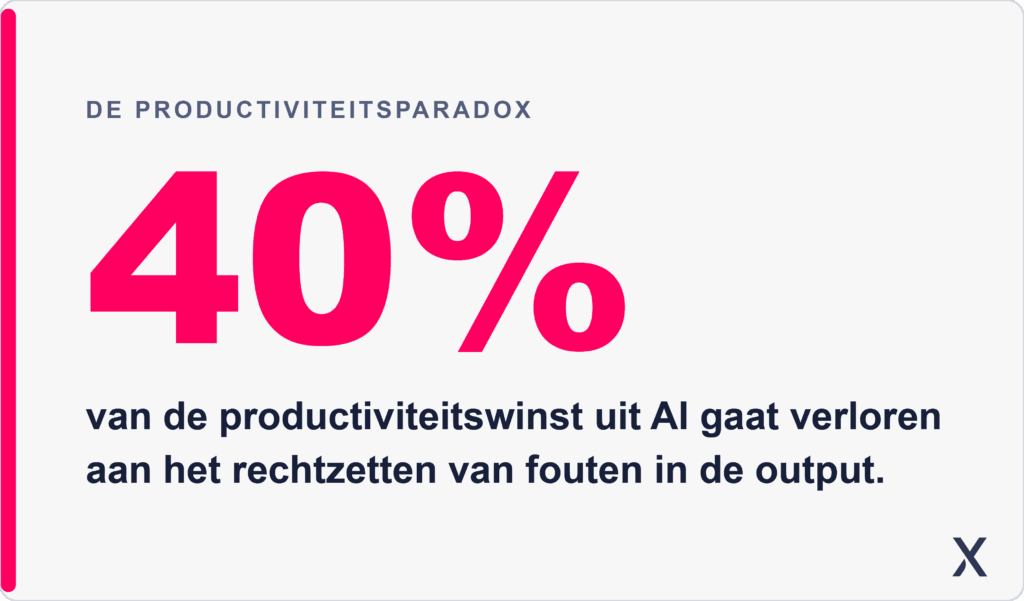
Meanwhile, Microsoft made the agentic features of Copilot in Word, Excel and PowerPoint generally available, with the assistant now also able to handle longer autonomous tasks in Excel and Word. An important step that further speeds up work in Office, though PCWorld rightly describes the assistant as an enthusiastic but inexperienced intern: readily usable for the rough work, provided you critically review the output. That fits with what research among CIOs finds: around 40% of the productivity gains from AI are lost again to fixing errors. A separate analysis draws an important conclusion from that: companies that choose AI augmentation over full automation gain more benefit in the long run. For anyone starting AI initiatives, that's an important guideline: invest as much in skills and governance as in tooling.
Claude Design: AI joins the design process
Anthropic launched Claude Design, a tool that puts together UI mockups, slides and infographics from natural language in no time. For anyone who wants to design a first version of an interface, a pitch deck or a report without immediately bringing in a designer or an outside agency, that's a notable step forward. The pace isn't entirely smooth yet, though: users report hitting their usage limits quickly.
On the other side, OpenAI released a revamped GPT-Image-2 that can also pull information from the web, although the generated layouts were judged superficially convincing, but unusable typographically and editorially. For anyone who wants to keep track of what this means for creative workflows, this analysis of what GPT-Image-2 actually changed is a good place to start. The message for marketing, communications and product teams is the same as in the previous section: AI speeds up the design process, but you're better off leaving the finishing touch and the editorial check to a human.
The Mythos saga: how to learn to read an AI announcement
In early April, Anthropic announced with great fanfare that its new Mythos model had, for the first time, managed to run a full cyberattack simulation, including finding weaknesses and building working exploits. The company even found Mythos too dangerous for public release and, through Project Glasswing, only made it available to a select group of partners. An announcement that landed squarely in the headlines.
But the hype quickly started showing cracks. Security researchers mostly found a 'nothingburger': most of the findings were already achievable with Opus 4.6 or existing open-source tools. Ethical hacker Inti De Ceukelaire built a working phishing tool with Claude live, in a few minutes. On top of that, the model deemed 'too dangerous to release' turned out to be accessible to anyone who could simply guess the URL.
The political story was also less clean-cut than it first appeared. Despite the Pentagon's earlier 'black list' statement, the NSA was reportedly already using Mythos through a separate channel, while the US cybersecurity agency CISA was left without access. When OpenAI released GPT-5.4-Cyber a week later, clearly positioned as a response, the tone was set. Mashable accordingly raises the pertinent question of whether Mythos is more of a PR stunt than a real breakthrough.
For organizations that need to assess AI claims, this is an instructive pattern: spectacular announcements rarely carry as much weight as press releases claim right away. The right reflex remains to look at independent research, security specialists, and the impact on your own risk profile.
Europe opts for sovereign alternatives
The tone in Europe is noticeably shifting toward digital sovereignty. Canada's Cohere is acquiring Germany's Aleph Alpha to build a transatlantic AI powerhouse, explicitly aimed at sovereign AI for European governments and companies. With backing from the German and Canadian governments, and an investment from Lidl owner Schwarz Group, the combined company is targeting a valuation of around 20 billion dollars.
Along the same lines, the Dutch government is setting up its own self-hosted alternative to GitHub based on the open-source Forgejo. The reasoning is always the same: less dependence on American Big Tech for critical infrastructure. For Belgian organizations reviewing their cloud and AI stack, that means a growing ecosystem of alternatives, and the need to make deliberate choices about where data, models and code reside.
The human remains the quality control
AI-generated content is flooding the internet at an astonishing pace. 44% of all new music on streaming service Deezer is AI-made, and China's iQiyi (often called the 'Netflix of China') is rebuilding its entire platform around mostly AI-generated films and series. At the same time, there's more attention going to provenance: VRT NWS is now showing an AI check on content that may have been AI-generated. Rightly so, since new research shows people barely manage to detect when their WhatsApp or email messages were drafted by AI.
Two studies also painfully expose the limits of AI as a source of advice. AI models get first-line patient diagnosis wrong in more than 80% of cases, and popular chatbots regularly give incorrect medical advice without users noticing. When researchers presented themselves to Grok as psychotic, the chatbot actively fed their delusions instead of pointing them toward help.
At the same time, the pushback is coming from a surprising corner. The strongest backlash actually comes from Gen Z, the generation that grew up with the technology. The Verge similarly argues that Silicon Valley is fixated on AI features the average user finds irrelevant or even annoying. And the earlier prediction that AI agents would roam around en masse as virtual employees by 2025 turns out, for now, to be overblown, although a Dutch advertising agency is openly cutting jobs because of AI tools, and LinkedIn has launched an AI labour marketplace for experts.
The common thread is clear: AI doesn't relieve us of critical thinking. Training employees in prompting, evaluating and reading critically therefore remains an indispensable part of any AI strategy.
We'll be back in two weeks with the next edition.
About Tom Van 't veld
Tom has worked at Xylos for years, where he started as a Microsoft Office trainer and grew into the driving force behind innovative learning concepts. He laid the foundation for OASE, Xylos' online learning platform, and developed, among other things, the Digital Coach concept, a Microsoft Teams Escape Room app, and the mAindset game that lets employees learn to work with AI in a playful way. As Learning Innovator, he has increasingly focused in recent years on what AI means for the way we learn and work. Want to react or chat further? Find him on LinkedIn.