Gradient blur
Blog
Artificial Intelligence
Learning Solutions
Managed Services
Back to overview

AI success requires more than technology

Organizations today are investing heavily in AI capabilities, from generative models to intelligent automation platforms. Architectures are being redesigned, budgets freed up, and possibilities keep expanding. Yet many AI initiatives never get past the pilot phase.
26 - 02 - 2026

The cause is rarely technical. It lies in the way organizations approach change. AI is powered by technology, but its value is realized by people. When employees aren't ready to integrate AI into their daily work, productivity gains fail to materialize, no matter how advanced the tools are.

AI success starts with people.

The structural imbalance in AI investments

In a recent interview with Fortune, Deloitte CTO Bill Briggs pointed to a striking imbalance: organizations spend an estimated 93% of their AI transformation budget on technology and only 7% on people.

Infrastructure gets funded. Employees are expected to adapt.

That imbalance becomes even clearer when viewed alongside broader transformation research. McKinsey has reported for years that only around 30% of transformation initiatives achieve a sustainable impact on performance. In other words, most large-scale change programs fail to deliver on their promises.

Research from Prosci also shows that organizations applying structured change management are up to 7 times more likely to achieve their objectives than organizations that neglect the human side of change.

Applied to AI, the conclusion is clear. Technology alone doesn't change an organization. Sustainable value is created when people adapt the way they work.

Why AI initiatives lose momentum

We see a similar pattern in both large enterprises and mid-sized organizations. AI tools are rolled out correctly from a technical standpoint. Governance and security are in order. Use cases are defined and early adopters start experimenting. Enthusiasm is high at first. Over time, momentum slows.

That slowdown is rarely caused by infrastructure limitations or model performance. It arises in day-to-day work. Employees are unsure when AI truly adds value. They lack confidence in formulating effective prompts. They find it hard to integrate AI output into existing processes or question the reliability of generated results.

AI creates new possibilities, but at the same time changes roles, responsibilities, and workflows. Without targeted guidance and clear frameworks, that shift remains incomplete. More technological capacity doesn't automatically lead to more productivity.

The real gap in AI transformation

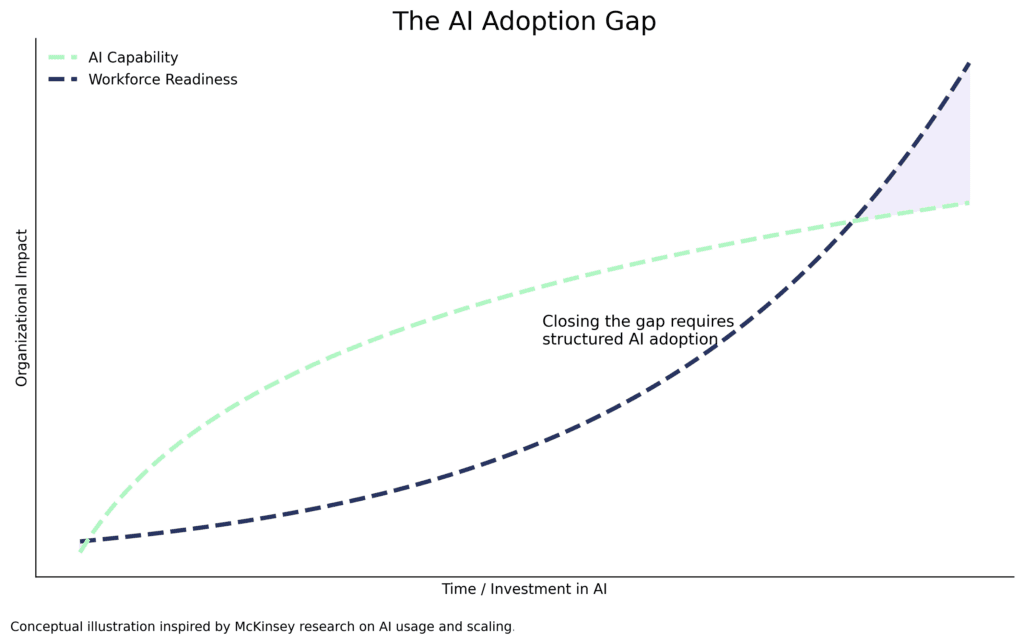
Today, the biggest challenge in AI transformation isn't access to technology. Most organizations can implement advanced AI solutions relatively quickly. The crucial question is whether employees are sufficiently prepared to use those capabilities effectively and responsibly.

AI changes how work is prepared, carried out, and evaluated. Reports are drafted faster. Data is analyzed more efficiently. Repetitive tasks are automated. Knowledge becomes accessible through natural language. But realizing those benefits takes more than a software license. It requires clarity about AI's impact on specific roles, practical skills in prompting and evaluation, and the confidence to embed AI structurally into daily workflows.

This is where it often goes wrong. Technology evolves quickly, but organizations adapt more slowly. Closing that gap requires a targeted, deliberate investment in people.

From awareness to measurable adoption

At Xylos, we don't approach AI as a purely technical implementation, but as an organizational journey. A secure, scalable digital foundation remains essential, as does integrating AI into processes to boost efficiency. But without employees who understand how to turn possibilities into value, that potential goes unused.

That's why we invest heavily in AI and data literacy.

AI literacy isn't a one-off training session. It's a structured journey from awareness to measurable adoption. We start with a baseline assessment to map the organization's starting point. We then align learning paths with specific roles, so relevance and applicability remain central. Interim pulse checks make progress visible, and a final report gives a clear picture of adoption levels and areas for improvement.

Measuring is crucial. Without insight into adoption, it's impossible to assess whether AI is genuinely contributing to productivity.

To make learning tangible, we combine structured programs with interactive formats such as the Copilot Escape Game, where teams apply AI in realistic scenarios, and the mAIndset Prompting Game, which strengthens prompting skills among employees with different levels of knowledge. These formats lower the barrier to entry and build confidence in practice.

Learning must connect to daily work. Confidence grows through experience. Impact must be demonstrable.

Organizations that invest in people make the difference

Large enterprises need scale and governance. Mid-sized companies often focus on speed and targeted impact. Despite these differences, they share the same challenge: aligning technology investments with the readiness and skills of their employees.

The organizations that will excel in the coming years are not necessarily the ones with the most advanced models. They are the organizations that systematically prepare their people to use AI thoughtfully, effectively, and responsibly.

AI may start as a technological innovation, but its long-term value depends on human adoption. AI success starts with people. And organizations that realize this in time will truly work smarter.