In this fourth article in our Data and AI series, you'll read how it works and why the architecture matters.

:focal())
An operations manager at a Flemish logistics company asks his new AI assistant which deliveries are at risk today. The assistant returns a list within seconds, perfectly worded, with supporting reasoning. One line immediately stands out: a shipment the assistant says has already been delayed for hours. The manager calls the driver. He's already been unloading at the right address for twenty minutes.
The assistant had made it up. The model never had access to the current transport data and answered the question based on patterns from its training, rather than on today's reality.
This isn't an exception. This is the pattern we see time and again in organizations that deploy AI without a foundation. And it's exactly why grounded AI exists.
What exactly is grounded AI?
Grounded AI is the architectural approach where you connect an AI system to reliable, current and organization-specific knowledge sources. The model bases its answers on facts you control, rather than solely on what it learned during training.
The opposite of that is a floating model: a language model that stands on its own, generates answers purely based on training data that's months or years old, and has no awareness of what's changed in your organization or in yesterday's world.
Grounding solves three fundamental problems that every unsecured AI system has.
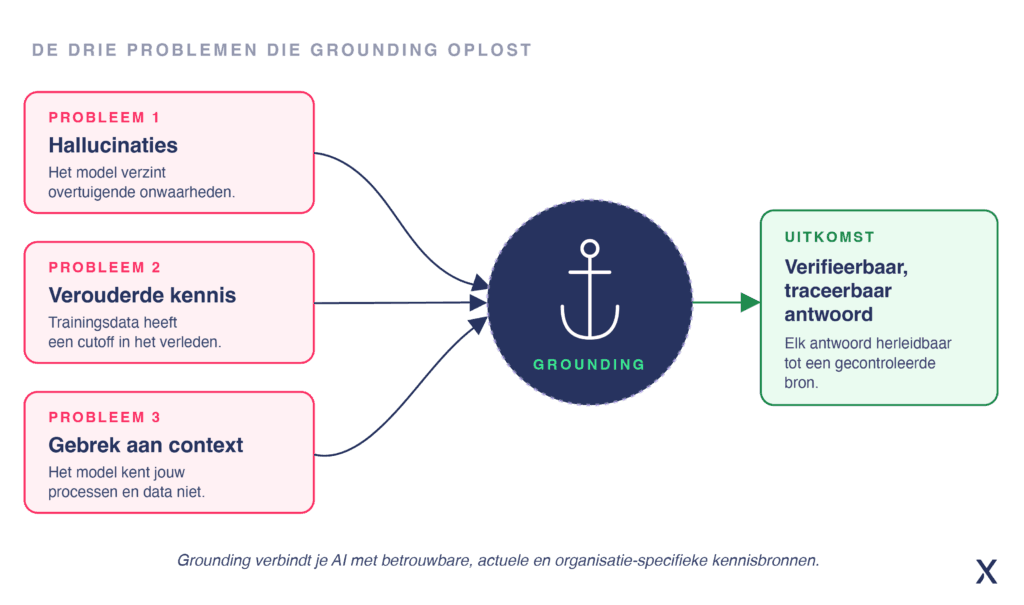
"An AI model without grounding is like an expert who sounds brilliant but makes up his facts. Impressive at first glance, very dangerous in production."
The three pillars of grounded AI
Grounding is more than a single technique. It's an interplay of three principles that you combine depending on the use case.
Retrieval-Augmented Generation (RAG). With every question, relevant information is first retrieved from a knowledge base: a vector database, a document store, SharePoint or your data lakehouse. That context is passed to the model, which generates an answer based on those sources. The result: answers that are traceable to sources you manage. This is the most widely used approach.
Fine-tuning on domain knowledge. The model itself is further trained on organisation-specific data. More expensive and slower than RAG, but powerful for applications where language style, domain terminology or specific reasoning patterns are crucial. An addition to RAG, not a replacement.
Tool use and live data integration. The model gets access to tools (APIs, databases, internal systems) that it can call in real time. Think of an AI assistant that retrieves live stock information, queries a CRM system or checks current legislation before it answers. This is the basis of modern AI agents.
When do you choose what?
The choice between RAG, fine-tuning and tool use is an architectural decision based on three parameters: how fast the information changes, how specific the domain knowledge is, and how much latency the use case allows. A concrete case makes it tangible.
The situation. A Belgian insurer wanted an AI assistant to help claims experts assess files. Policy terms change, case law evolves, and every file requires access to customer data and history.
The solution. RAG for the policy documentation and legal sources, tool use for live customer data from the core insurance system, and light fine-tuning on the language used in claims reports.
The result. An assistant that proposes a well-founded assessment within thirty seconds, with explicit source references for every statement. The expert still decides, but works three times faster and with less risk of missing a clause.
So in most enterprise use cases, you combine all three principles. And that brings us to the architecture that makes this possible.
"Grounding isn't a choice between safety and speed. Organizations that implement it well get both: AI that's blazing fast and demonstrably reliable."
The five-layer architecture
A grounded AI system is built up in five layers. Read the architecture from top to bottom as a question traveling through the system, and from bottom to top as the information flow that underpins the answer.
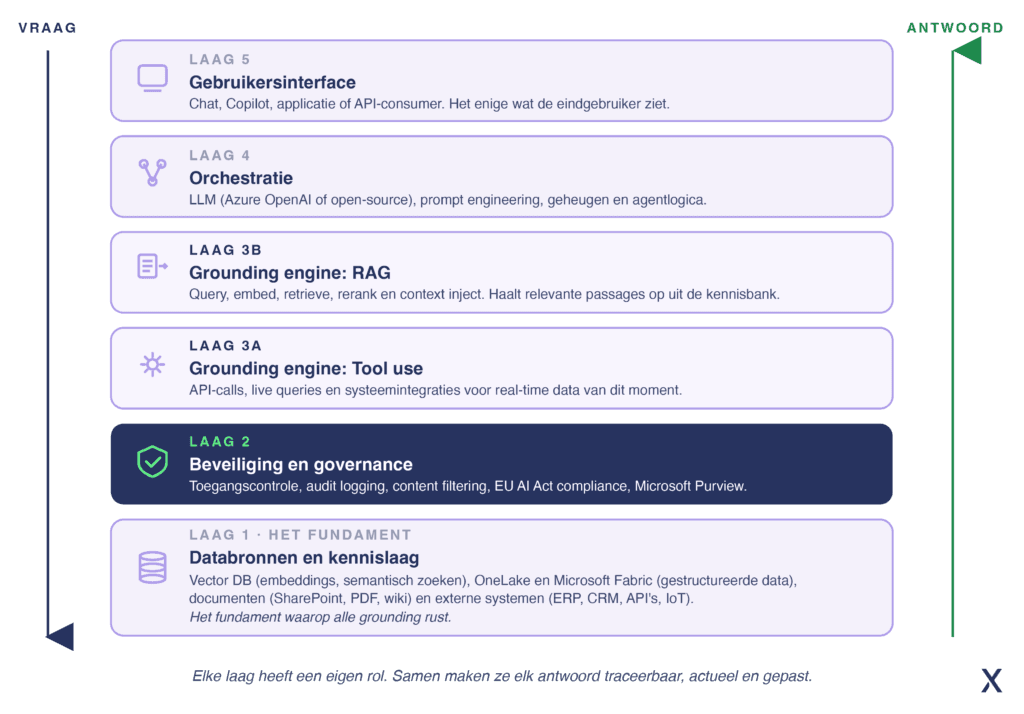
The user interface is the only thing the end user sees. What's behind it is completely transparent to them, but as an architect or IT leader, it's precisely that hidden infrastructure that makes the difference between a trustworthy system and a risky toy.
The security and governance layer is what makes grounded AI enterprise-worthy. Access control ensures an employee only sees information they're authorized for, even if that information is technically available in the knowledge base. Audit logging makes every answer traceable. Through Microsoft Purview, you integrate this seamlessly with your existing compliance framework and the requirements of the EU AI Act.
Together, this forms a system where, as an organization, you can always say: this answer is based on this source, at
How do you implement this safely in your organization?
The architecture above is the end goal. The path there unfolds in five steps, and that order isn't arbitrary.
Lay the data foundation. Make sure your core data, policy documents, product information, process manuals and customer data are accessible, up to date and clearly owned. Without this, grounding is built on sand. Microsoft Fabric and OneLake are the most pragmatic choice here if you already work in the Microsoft ecosystem. Read our article on why your AI strategy starts with your data foundation.
Define your security perimeter before you build. Which user may see which information through the AI? That is not an afterthought, but an architecture decision you build in from day one. Role-based access control, combined with Microsoft Purview for audit trails, is the enterprise standard.
Start with a clearly scoped RAG use case. Pick an internal use case with a clear success criterion: an HR knowledge assistant, a technical documentation search engine, a contract analysis tool. Quick results, manageable risk, and an architecture you can extend afterwards.
Extend with tool use and agents. Once the RAG foundation is stable and has built trust in the organisation, you add live data integrations. Agents that handle several steps autonomously are the end point, but they need a mature grounding foundation to operate safely. Read more about this in our article on Power Platform as the most underrated AI bridge.
Monitor, evaluate and keep improving. Grounded AI is not a project with an end date. Measure the quality of answers systematically, monitor which sources are used most often, and adjust your knowledge layer based on what the system teaches you about the information needs in your organisation.
"Grounded AI isn't the endpoint of your AI journey. It's the foundation on which everything that comes after can be built safely and reliably. Agents, automation and decision support all start here."
The question is no longer whether you deploy AI, but how
Organizations that embrace AI today without grounding are building on a foundation that will sooner or later collapse. One flagrant error from a hallucinating system (a wrong diagnosis, an incorrect contract, a fabricated compliance check) and trust in AI within the organization is damaged for a long time. It gets even worse when faulty information goes public and hits your reputation.
So the question is no longer whether you should deploy AI. The question is how you build it so you don't squander that trust. The answer is grounded AI: the combination of architecture, governance and data that makes every answer traceable, current and appropriate.
Xylos helps you build grounded AI: architecture and adoption
At Xylos, we combine deep technical expertise in data architecture, Microsoft Fabric, Azure AI and open-source models with a pragmatic approach that starts from your business question, not the technology.
We guide organizations through every step: mapping out the initial data strategy, setting up the RAG foundation, and rolling out production-ready grounded AI systems that employees trust every day.
Want to get started with a first RAG use case, ground an existing AI system, or build out a full enterprise AI architecture? Xylos brings both the technical depth and the organizational context needed to make that succeed sustainably.
Also read the other articles in this series
This is the fourth article in our Data and AI series. Earlier, you can read how AI sprawl and shadow IT emerge in 2026, why the Power Platform is the most underrated AI bridge, and why your AI strategy starts with your data foundation.
Want to talk through what grounded AI would look like for your organization? Our AI architects are happy to think along with you about your data foundation, your use case and the architecture that fits your risk profile. Get in touch for an exploratory conversation.
About the author
[Peter Verrykt](https://be.linkedin.com/in/peter-verrykt) is Data and Analytics Business Lead at Xylos and guides organizations in turning data into concrete business value. He helps companies look beyond technical implementations and use data as a foundation for better decisions, greater agility and sustainable growth.