Microsoft and OpenAI made their partnership less exclusive, Copilot made a remarkable leap forward, Accenture is rolling out AI to 743,000 employees while Cloudflare just cut a thousand jobs, security researchers flagged a new weak spot in AI stacks, and closer to home came a telling figure: half of secondary school students use AI for schoolwork every week. Every two weeks on the Xylos blog, we bring you a sharp and honest overview of what's really moving in the world of generative AI, with the context you need.

:focal())
The foundation remains the biweekly LinkedIn overview by Tom Van 't veld, Learning Innovator at OASE (powered by Xylos). Tom follows AI developments closely, and we translate his observations into what they concretely mean for organizations and the people working in them. Welcome to edition three.
EDITION 3 • MAY 11, 2026
Below are five stories from the past two weeks that matter most for your organization.
Microsoft and OpenAI: the end of the monogamous relationship
The biggest business news of the past two weeks: Microsoft and OpenAI have thoroughly restructured their partnership agreement. Microsoft keeps its license to OpenAI's models until 2032, but it's no longer exclusive. Within 24 hours, Amazon struck its own OpenAI deal through AWS Bedrock, while Microsoft itself is deliberately betting on a broader range of models. A good example of that multi-model approach: the new Legal Agent for Word combines Microsoft tooling with Claude under the hood.
For Belgian organizations, choosing which AI stack sits behind which use case matters more than ever. The key questions for customers today mostly revolve around where your data ultimately gets processed and how deliberately and flexibly you manage your model mix. The end of exclusivity opens the door to multi-model strategies, and demands tighter governance on the business side.
Copilot comes of age, in Outlook and legal workflows too
Microsoft made Copilot's agentic features in Word, Excel and PowerPoint generally available. Copilot now carries out multistep edits in documents and presentations while the user keeps control. In edition 2, we were still cautious about this. After further testing, Tom has to admit he's come around: the results genuinely hold up. One caveat still worth flagging: an agent sometimes takes a roundabout way to complete a task, so a quick review still belongs in the process for production files.
On top of that, Copilot in Outlook is getting agentic features to manage your inbox and calendar, for now limited to Frontier customers with a gradual rollout to broader user groups. And then there's the earlier-mentioned Legal Agent for Word for contract analysis and redlining, currently only available in the US. Anyone who wants to make the most of agentic features without surprises still does best to invest in internal review processes and targeted adoption support.
The big AI rollouts: Accenture, Cloudflare, and everything in between
Accenture is rolling out Microsoft Copilot to all 743,000 of its employees, the largest enterprise Copilot deal to date. At the same time, Cloudflare announced it is cutting 1,100 people, around 20% of its workforce, as it moves toward an 'agentic AI-first' business model. CEO Matthew Prince stresses this isn't a cost-cutting move — Cloudflare just posted 34% revenue growth. Though for those affected, that's probably cold comfort.
Most Belgian organizations sit somewhere between those two extremes. Boosting productivity with AI rarely works by simply handing out licenses. It requires a phased rollout with training, communication, governance, and clear agreements about the role of AI per job profile. Good guidance is what makes such a rollout genuinely pay off.
Cybersecurity: credentials are the new target
Six research teams spent nine months documenting how Claude Code, GitHub Copilot, Codex and Google's Vertex AI were hacked. The common thread: every attacker specifically targeted the credentials the AI agent held. The valuable prize for attackers lies in every system the agent has access to.
Two illustrations of how large that attack surface has already become. Five thousand 'vibe-coded' apps built with Lovable, Replit and Base44 turned out to be sitting on the open web with no authentication at all, exposing medical records, financial data and internal strategy documents. Around the same time, Microsoft itself disclosed three critical vulnerabilities in Microsoft 365 Copilot and patched them immediately on the cloud side. That kind of proactive disclosure is what mature platforms do, while also being a reminder that every new AI layer brings new things to watch.
The Mythos saga from the previous edition gets a sequel in the meantime. Mozilla reported that Mythos found 271 weaknesses in Firefox in two months with almost no false positives, and the NSA is using Mythos for vulnerability research in mainstream software, including Microsoft's. The message for security teams is clear: AI agents in your stack demand just as much attention to identity and access management as choosing the models themselves.
AI in the classroom: time to take AI literacy seriously
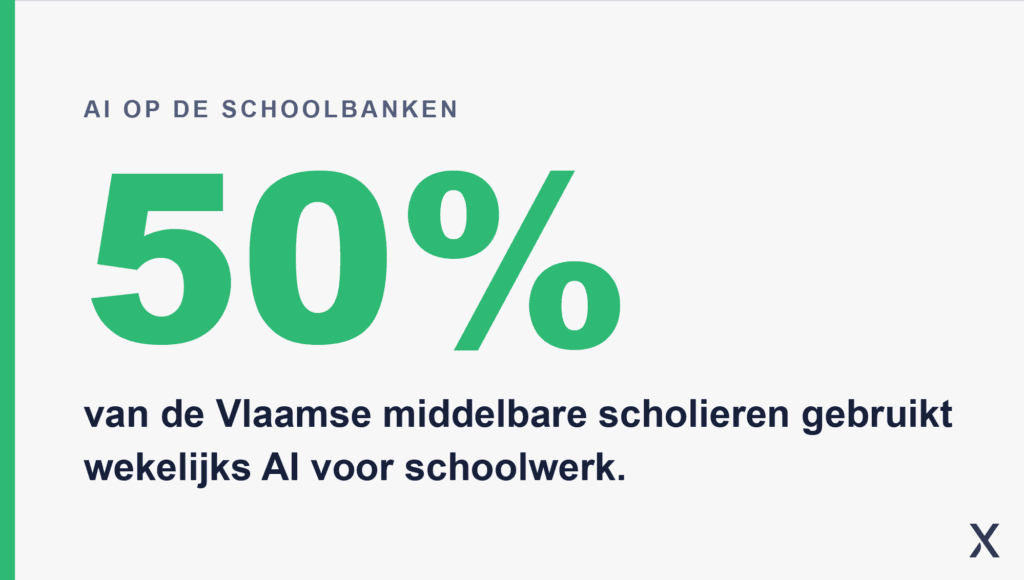
A telling figure came from close to home: half of Flemish secondary school students use AI for schoolwork every week. Fourteen percent outsource assignments entirely to AI, and 35% rarely check the output. The encouraging part: the students themselves are asking for clear guidelines.
The question goes beyond education alone. AI literacy starts in the classroom and keeps growing in the workplace. Whoever is entering the job market now brings these habits along, both the clever ones and the worrying ones. For organizations, that's a two-sided invitation: support teachers and lecturers on the intake side, and keep training internal employees on the work side. You build AI skills through an ongoing competency journey with regular upskilling.
We'll be back in two weeks with the next edition.
About Tom Van 't veld
Tom has worked for Xylos for years, where he started as a Microsoft Office trainer and grew into the driving force behind innovative learning concepts. He is at the origin of OASE, Xylos's online learning platform, and developed, among other things, the Digital Coach concept, a Microsoft Teams Escape Room app, and the mAindset game that helps employees learn to prompt with AI in a playful way. As Learning Innovator, his focus in recent years has increasingly turned to what AI means for the way we learn and work. Want to react or keep the conversation going? Find him on LinkedIn.