Memory modules (RAM) and SSD storage have become drastically more expensive in a short time, and the end is not yet in sight. As Partner Alliance Manager at Xylos, I see this popping up daily in customer quotes, renewals, and expansion projects. What exactly is going on, and what can your company do about it?

:focal(undefined))
Prices quadrupling within a few months
We're no longer talking about a slight indexation or a limited price adjustment. In recent expansion projects, we saw RAM module prices multiply by a factor of four or even five compared to what they cost just a few months earlier. Enterprise SSDs show a similar story.
What's remarkable is that these price levels are also unstable: suppliers today issue quotes that are only valid for two to three weeks, sometimes even just fourteen days, precisely because they themselves lack sufficient certainty about supply and cost price.
This time, the dollar exchange rate isn't the main culprit
Unlike during the corona period, the dollar exchange rate plays a much more limited role today. Some hardware is of course still priced in USD, but in recent projects we see that price increases don't follow proportionally from exchange rate fluctuations. The core of the problem lies elsewhere: in the availability of critical raw materials, in energy costs, and in production capacity in the semiconductor sector.
The Strait of Hormuz: an indirect but real impact
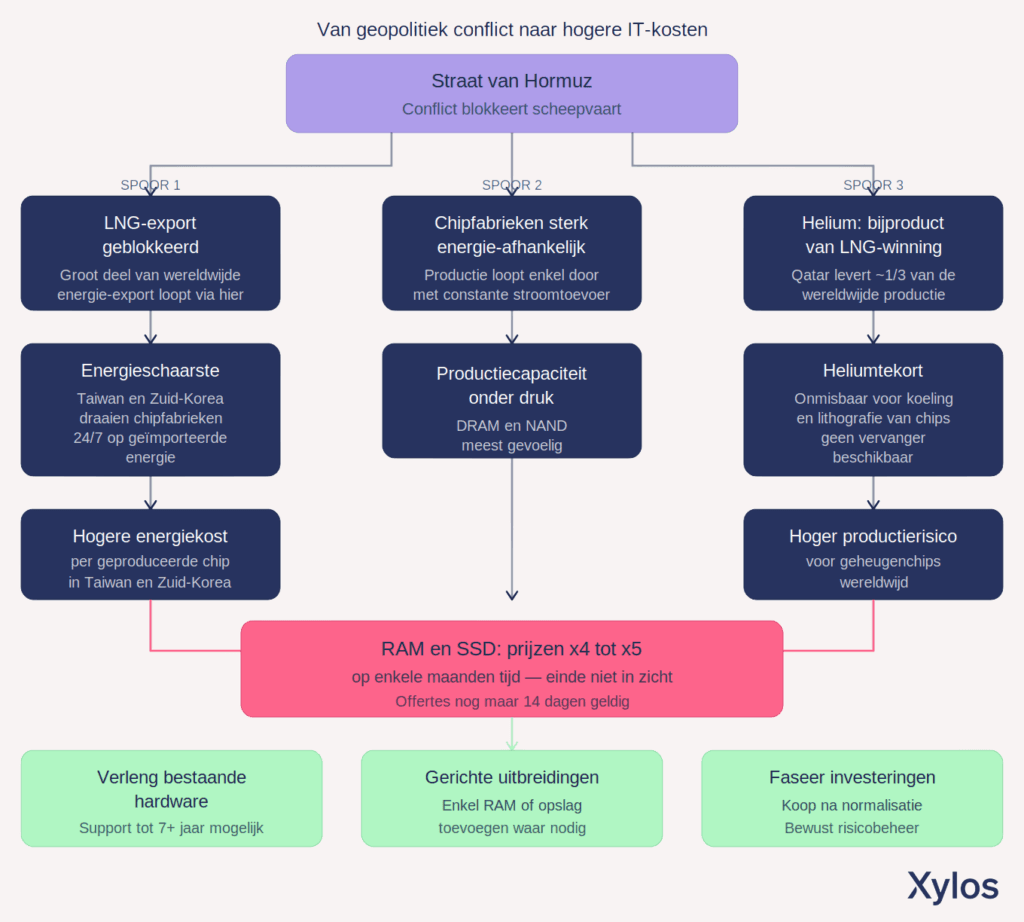
Recent geopolitical developments have added a new factor of uncertainty. The (partial) closure and disruption of the Strait of Hormuz has no direct effect on chip factories in Europe, but it does have a demonstrable indirect impact on global semiconductor production.
Several independent analyses show that:
A significant share of global LNG and energy exports passes through this route
Major semiconductor production regions such as Taiwan and South Korea are heavily dependent on imported energy to keep their factories running 24/7
Helium, an essential gas for chip production (cooling, lithography), largely comes as a byproduct of LNG from the Gulf region, with Qatar alone supplying roughly a third of global helium production
Disruptions in this chain don't necessarily lead to immediate production stops, but they do raise the cost price, risk, and volatility of memory and SSD production. Several analyses warn that memory chips (DRAM and NAND) in particular are sensitive to this.
What can you concretely do about this?
In this context, it's important not to automatically assume that "replacing is better". An often underestimated but very rational alternative is:
Continuing to use existing servers and storage for longer, especially when they're still technically sufficient
Manufacturers today often offer the option to extend support to 7 years or more, including firmware, parts replacement, and support
Limited, targeted expansions (e.g. extra memory or storage where strictly needed) can significantly extend the lifespan
Once the market normalizes, you can re-evaluate and only then carry out a full hardware refresh
Deliberate risk management, not procrastination
Postponing purchases can sometimes sound like passivity, but in the current context it's the opposite. Anyone who carries out full hardware refreshes today, at the peak of a volatile market, takes on unnecessarily high costs for the organization. Anyone who links timing to a clear analysis of the state of the infrastructure and market developments is practicing active risk management.
That does require a precise view of the state of your current infrastructure, of what's contractually extendable, and of the critical thresholds at which you really need to act. This is exactly where we at Xylos help our customers: translating technical choices into an economically sound approach, with an eye for continuity today and smart timing tomorrow.
In conclusion
My message is not an argument against renewal, but for considered timing. The current price pressure on RAM and SSDs is the result of structural factors in the global semiconductor chain, not of temporary market whims. By being smarter about lifespan, expansions, and purchase timing, organizations can bridge this period without sacrificing continuity or performance.
Want to know how to make the most of your current infrastructure under these market conditions? Our team is happy to look together with you at the smartest approach for your specific situation.
About the author
Frank Dierckx is Partner Alliance Manager at Xylos and follows the evolution of hardware ecosystems, supplier relationships, and infrastructure projects on a daily basis. His expertise helps customers make technology choices that are technically sound and economically responsible.