With the port as a backdrop, the central question was on the table: how can logistics organizations regain control over an increasingly complex system landscape? An afternoon full of strategic insights, a strong customer case on low-code logistics, and a first look at the future of enterprise low-code.
:focal())
A warm welcome
Benny Moonen, Commercial Director at Xylos, opened the afternoon and immediately set the tone. In a sector where change is the only constant, it's not the number of systems that makes the difference, but the control you have over them. He told the audience that low-code, data, and automation aren't separate buzzwords, but building blocks that together make the difference between reactive management and proactive steering.
Orchestrating the Digital Port: the Xylos perspective
Peter Verrykt, Business Unit Lead Data & AI and Automation at Xylos, opened the content with a sharp diagnosis of the logistics reality. What was once a linear chain has today become a living ecosystem. Shipping lines, terminals, customs, transport, and digital platforms form a network of mutual dependencies, constantly under pressure from changing routes, evolving regulations, and shrinking margins.
According to Peter, the real problem in that landscape isn't a lack of technology, but rather the proliferation of tools. Too many point solutions, too little coherence, and integrations that are fragile rather than fundamental. The classic reflex of adding another system for every new problem only makes the whole thing more vulnerable. So the right question isn't which technology is still missing, but how you gain control over the whole.
The answer to that is orchestration. Using the port as a metaphor: success isn't determined by the number of cranes or ships, but by how well everything is aligned. Who sets the rhythm? Who has the overview? Organizations that make the difference position themselves as the conductor, rather than the operator of individual instruments.
According to Peter, orchestration rests on two foundations: data as the backbone and automation as the lever. A well-thought-out data structure is the precondition for real operational control, and automation isn't a goal in itself but a means to eliminate repetitive work, support decisions, and let processes move dynamically with reality.
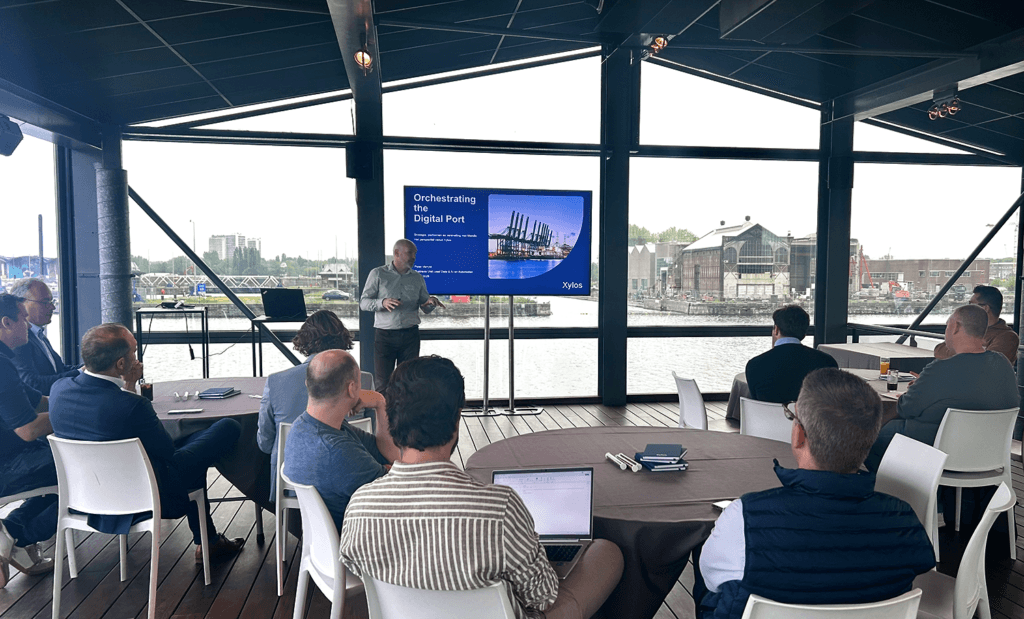
That's why Xylos deliberately opts for a platform-driven approach with Mendix as the foundation. The platform combines speed and structure: rapid development, easy integration with existing TMS, WMS, and ERP systems, scalability, and central governance. Existing systems stay active and stable, while new functionality is built on top. That way, Mendix becomes an orchestration layer that harmonizes data and coordinates processes, not just another layer on top of the existing chaos.
In that context, the role of IT is fundamentally shifting, says Peter. Where IT used to mainly manage systems, CIOs and IT leaders today are becoming enablers of business transformation. In a sector facing geopolitical tensions, changing trade routes, and new ESG and customs requirements, flexibility is no longer a luxury but an operational necessity.
The Ahlers case: from fragmentation to a digital platform
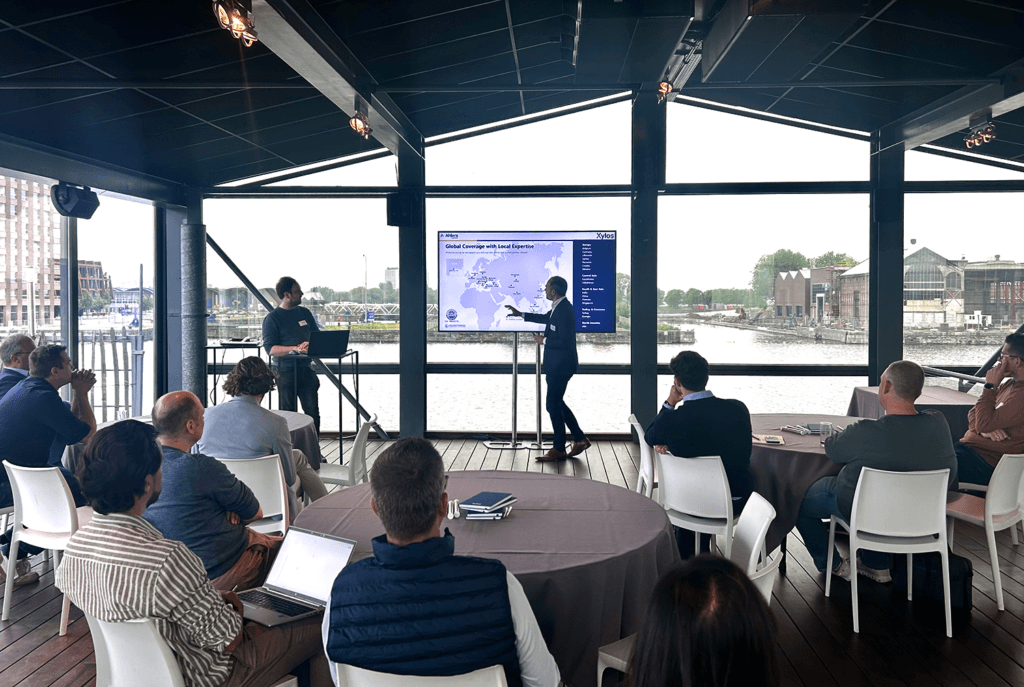
The highlight of the afternoon was the case of Ahlers, presented by Dimitri Aerts, IT Director at Ahlers. Ahlers is a family business with more than 115 years of experience, headquartered in Antwerp, with offices in 15+ countries and more than 220 employees worldwide. An organization with a strong local-global profile, and the corresponding IT complexity that comes with it.
Dimitri outlined how three triggers led Ahlers to make a central digitalization investment. Customers were making ever-higher demands that the existing structure could no longer handle. There was also a need for central control in an environment where IT had historically been organized partly per country. And finally, the geopolitical reality: the war in Ukraine forced a carve-out of the Russian branch, which at the time held a large part of the IT expertise.
Ahlers opted for a best-of-breed central IT architecture with clearly defined positions for CRM, TMS, ERP, and data lake. To fill the IT gaps, with transparency and automation of the order-to-cash flow as the main use case, Ahlers went through a thorough selection process lasting several months, weighing Mendix against Salesforce and high-code alternatives. The choice ultimately fell on Mendix because of its leadership position in the Gartner quadrant, an attractive business case, a predictable OPEX model, and the stability a European vendor offers in a geopolitically uncertain climate.
A discovery workshop mapped out the end-to-end automation flow, covering CRM opportunity, order intake, TMS planning, cost transparency, real-time margin management, payment-milestone-based invoicing, and document generation. Ahlers deliberately chose to start with document generation, since that's where the biggest operational efficiency gain lay.
The Mendix project works with two-week sprints, a living backlog, and a clear separation between the roles of developers, product owners, and business stakeholders. After just six weeks, Ahlers was able to demonstrate a v0.1 to the business. The biggest pitfall Dimitri shared tied in nicely with Peter's message: Mendix development moves so fast that the business itself becomes the bottleneck. Clear processes and available stakeholders are therefore at least as important as technology.
Next, Sam Loeys, Senior Low Code Solution Architect at Xylos, took over for a live demo of the Ahlers solution. He showed the audience how automated document generation, the matching of supplier invoices with cost lines, and margin transparency work in practice within the Mendix platform. Tangible proof that a platform-driven approach doesn't have to be an abstract promise.
Low-code in an AI world: the Mendix vision
In the third session, Pieter Vercammen, Solutions Architect at Mendix, took the audience through the future of low-code in an AI-driven world. He started from a simple observation: 76% of CIOs report rising demand for new digital products, while a third of all software projects run more than six months behind schedule. AI seems to be the answer, but AI is only as valuable as the software that makes it usable.
Pieter outlined how agentic applications are quick to get started, but become complex to trust, govern, and scale. The solution lies in bringing software and data teams together within a platform that supports the full stack, spanning data integration, AI orchestration, agent governance, and application development.
That platform was unveiled as an exclusive preview at the event: Mendix's Agentic Enterprise Platform, officially launching on 12 May 2026. It brings together Mendix Application Development, RapidMiner Universal Data Integration, and RapidMiner AI Acceleration into a foundation for AI-augmented applications, cross-domain analysis, and agentic automation. With features such as Maia for AI-assisted development, an agent builder, conversational UI, human-in-the-loop workflows, and observability, Mendix aims to help organizations build faster within a manageable framework.
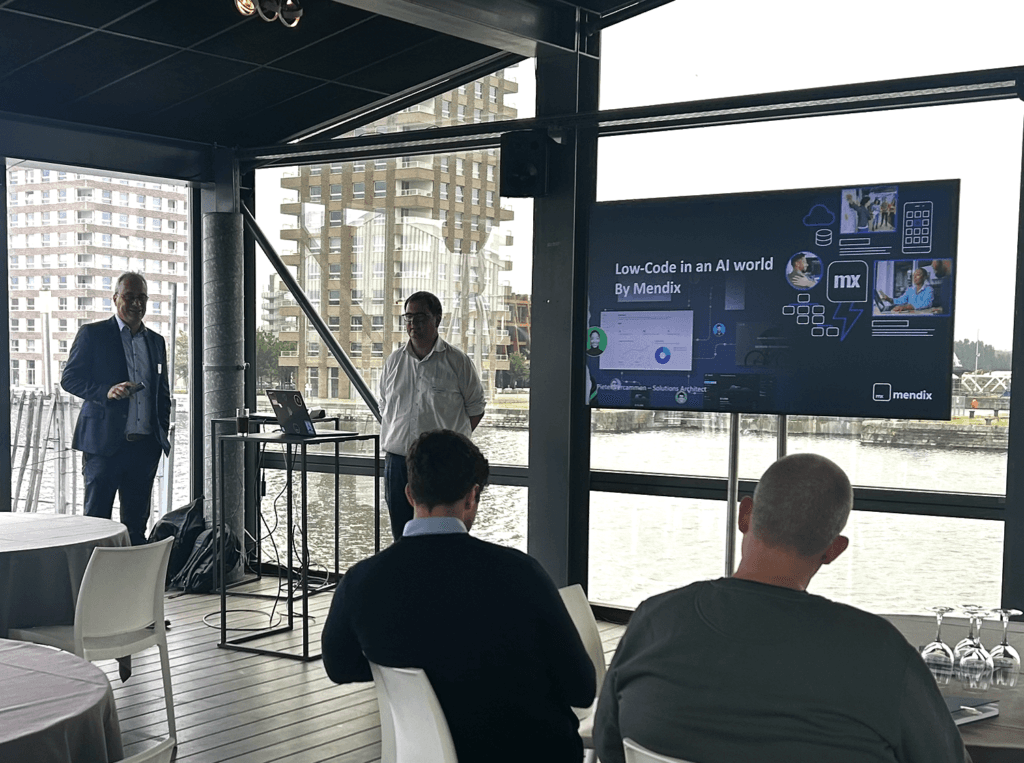
The message Pieter left the audience with: low-code and AI aren't competitors, they reinforce each other. Vibe coding only makes low-code platforms more powerful, provided the governance layer evolves along with it. And in a geopolitical context where sovereignty over data and platforms is becoming increasingly important, a European low-code player like Mendix offers a solid foundation.
Engaging conversations on board
The afternoon ended as it should: with bites, drinks, and engaging conversations on board. The logistics leaders in attendance clearly recognized themselves in the challenges discussed on stage and eagerly shared their own experiences, questions, and plans. For the Xylos team, those conversations were at least as valuable as the presentations themselves — they show that the topic is truly alive in the Belgian logistics sector.
Ready to build your own digital port?
Want to know what low-code, data, and automation can mean for your logistics processes? Xylos offers participants an Orchestration Scan: a short analysis of your current data landscape and process architecture, with concrete recommendations for a platform-driven approach tailored to your organization. Get in touch to schedule one.