Our Partner Alliance Manager Frank Dierckx is in Las Vegas this week for HPE Discover 2026. In this second part of his series, he shares his reflections after the keynote by Rami Rahim, the man behind HPE's networking division since the Juniper acquisition.

:focal())
The event itself is a big AI story this year. On the posters, in the demos, and on the stages, everything revolves around models, agents and new use cases. But anyone listening closely to the keynotes notices that the real conversation sits one layer deeper, namely in the infrastructure that has to carry all that AI.
In my previous blog, I already wrote that the real challenge of AI rarely lies in AI itself, but in the foundation beneath it: network, data, compute and security. At the Partner Growth Summit, CEO Antonio Neri summed it up with a title that says it all, namely that building for AI starts with your network. On the main stage, Rami Rahim then dives deeper into that, which is why that one foundation deserves a blog of its own.
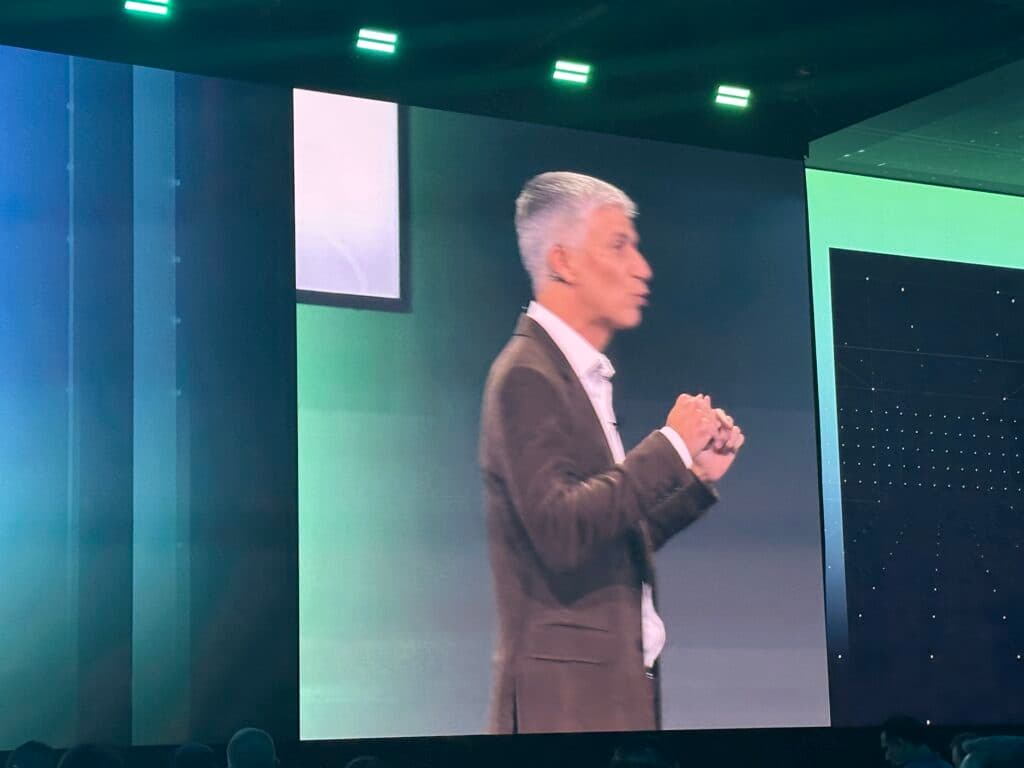
For those who don't know Rahim: he spent years at the helm of Juniper Networks and, since HPE's acquisition, now leads the entire networking division. He's a driven speaker who effortlessly carries a room, and his story stuck with me.
Rahim opens with an image that sums it all up. He refers to the Millennium Tower in San Francisco, a prestigious residential tower that started sinking years after completion because its foundation couldn't carry the load. His message is sharp: build your AI ambitions on a shaky foundation, and the whole thing eventually collapses. And that foundation, he argues, is today your network.
HPE's acquisition of Juniper gives that message extra weight. The whole networking story gets remarkably much attention here, and it becomes clear why HPE is betting so heavily on this domain. For me, it sums up the biggest shift I'm seeing this year: the network is no longer infrastructure, it's the platform.
The network is no longer a background layer
For years, we talked about storage, compute and cloud as the engines of innovation. The network sat somewhere in the background. Important, sure, but rarely something a board of directors got excited about. Today, that logic is completely reversed.
The reason is simple. AI places extreme demands on your environment. Massive data traffic, real-time inferencing and low latency require an infrastructure that can continuously scale along. As soon as one of those links falters, the performance of your entire AI application drops. Or as it was put on stage: AI innovation can only move as fast as the network allows. On the work floor, that's simply the reality.
Two movements at once: AI on the network and AI in the network
What I find compelling is that the story doesn't stop at "networking is important." It goes a step further. We're actually in the middle of a dual evolution.
On one hand, the network needs to be able to handle the AI workloads themselves. That's about networks for AI. On the other hand, AI is increasingly taking over the management of that network. That's AI for networks. Rahim puts it beautifully: the future of networking will not just support AI, it will run on AI.
You can already see that concretely today. Networks that steer themselves, AI that spots problems before a user even notices them, optimization that happens automatically. Today, this is already fully running in production.
HPE makes that tangible with new hardware and software built specifically for this wave. Behind the scenes, management platforms that used to stand apart, such as Aruba Central, Mist and OpsRamp, are increasingly merging together. The signal is clear: the network is now conceived as one coherent platform, no longer as a collection of separate devices.
Self-driving networks are finally becoming concrete
Over the past few years, I've often seen "AI in networking" come up. Mostly, it stayed at the level of dashboards and alerts. What we're seeing now is fundamentally different. Systems detect a problem, determine the cause, and solve it without a human needing to intervene.
Someone put it very aptly during a session: if humans still have to fix the problem, where exactly is the self-driving? That, for me, is the crux of it. This goes beyond tooling that supports the administrator. It's about a new operational reality in which the network largely keeps itself running.
Security moves inside the network
A second evolution I notice: security and networking are merging. That makes sense too, since every attack travels through the network and every action leaves network traces. Security therefore belongs woven into the network itself.
In practice, that means zero trust extending into the network layer, AI that recognizes abnormal behavior, and policy that automatically triggers a response. The network thus becomes your first line of defense and your detection system in one.
For security teams, that's a relief. They've long been facing a growing attack surface and a shortage of hands to keep up with it all. When detection and response happen within the network layer itself, you win precious time at the moment it truly matters. The question then shifts from "do we spot the attack in time" to "how fast does the network respond autonomously".
What this means for your organization, and for us
The impact reaches further than technology alone. Three things stand out to me.
First, the network is back on the boardroom table. The question moves upward: do your AI applications keep performing when usage peaks, what does that do to your user experience, and what risk comes with it? Those are decisions with a price tag and a business impact, and therefore belong with leadership, not just IT.
Second, this forces a different way of working in operations. The classic reflex of monitoring, opening a ticket and then fixing it gets stuck on the speed and complexity of an AI environment. Autonomous management takes over the routine work, freeing up your IT team's time for the work that truly moves your business forward.
Third, the role of a partner changes. For us at Xylos, networking becomes a fixed part of every trajectory around AI, cloud and security, rather than a separate chapter you still sort out afterward. Anyone who keeps looking at those layers in isolation is once again building on a shaky foundation. That's exactly the mistake Rahim wanted to expose with his tower.
What I'm taking away so far
The event is still in full swing, but the common thread through these first days is already clear to me: AI is only as strong as the foundation you build it on. That foundation consists of your data and your integrations, but above all, your network.
We've said for years that data is the new gold. Maybe that's still true. But if you ask me today what will truly be decisive, it's not who has the most data. It's who has their network best under control. Because without a performant, intelligent and secure network, no AI ambition gets off the ground. Otherwise, Rahim's tower simply keeps wobbling.
There's actually a second keynote on the program that particularly intrigues me, and I'll come back to that in my next blog. For now, I'm curious how you experience the network today. Is it already a boardroom-level conversation topic at your clients, or is it still tucked away in the technical layer?
About the author
Frank Dierckx is Partner Alliance Manager at Xylos and follows the evolution of infrastructure, partner ecosystems and emerging technologies. His expertise helps clients make technology choices that are technically sound and economically justified.