Every two weeks, we publish a sharp and honest overview on the Xylos blog of what’s really happening in the world of generative AI, complete with the necessary context. The foundation for this remains the biweekly LinkedIn roundup by Tom Van ‘t veld, Learning Innovator at OASE (powered by Xylos). Tom closely follows AI developments, and we translate his observations into what they actually mean for organizations and the people who work there. Welcome to edition six.
EDITION 6 • JUNE 22, 2026
Here are five stories from the past two weeks that are most beneficial to your organization.
The Fable Story: A Commercial AI Model That Was Shut Down with a Single Directive
On June 9, Anthropic launched Claude Fable 5, the first model in the Mythos class. Three days later Anthropic disabled both models worldwide. The U.S. Department of Commerce had issued a directive to deny access to foreign nationals, based on export regulations and national security concerns. In a shared cloud, real-time verification of nationality is unfeasible. A global shutdown proved to be the only practical option.
The reason turned out to be trivial. Amazon CEO Andy Jassy had mentioned in a conversation with the U.S. government that his researchers had extracted information using Fable. That information could be used for cyberattacks. According to one researcher involved, the dreaded “jailbreak” amounted to simply reading and improving a piece of code—something that works just as well with other models, including GPT-5.5. Security researchers called the ban “dangerous” and described the model as “not a unique risk.”
For Europe, the debate over technological sovereignty immediately returned to the top of the agenda. France spoke out in support of Mistral. The European Commission is examining the practical implications. Anthropic is updating its privacy policy so that U.S. citizens can regain access via an identity verification process (starting July 8). For business users outside the U.S., this offers little hope.
For Belgian organizations, there is a principle at play here that takes precedence over the specific model. A foreign government can shut down a commercial AI model used by hundreds of millions of users with a single directive. This threatens the continuity of any organization that relies on a single AI vendor for critical workflows. The right response is to to actively avoid vendor lock-in. Build your AI stack flexibly enough to switch to a different model when necessary. Base critical processes on a well-considered mix of vendors, with a clear migration path in case one vendor drops out.
Copilot Cowork is generally available, and the billing is variable
On June 16, Microsoft Copilot Cowork generally available. Cowork is the agent layer of Copilot. It independently performs complex, long-running tasks rather than simply offering suggestions. A new button has appeared in the Microsoft 365 Copilot app to switch from chat to Cowork mode. Users who do not yet have a license will see a “Request Access” button.
An important detail for European organizations: Cowork currently runs on Anthropic models. That data is processed outside the EU. GPT models will be added soon (already available for testing in the Frontier program), and those are expected to run within the EU. Microsoft is also announcing its own, more affordable model, “Cowork 1,” for standard tasks.
The biggest change is in the pricing model. Cowork is not included in the standard Copilot license; you pay for it separately using Copilot Credits. Each task is billed based on four factors: the selected model, the context retrieved, the number of tools used, and the duration. Microsoft categorizes tasks as light, medium, and heavy. A light task costs about $1 to $3—for example, a short summary. A heavy task can cost up to $7 or more—such as comparing thousands of files between two product versions. Both pay-as-you-go and a pre-defined P3 volume with a discount are available.
For IT managers and CFOs, this represents a fundamental change in the way you budget for AI. A variable cost structure requires monitoring and clear agreements that weren’t necessary with fixed monthly licenses. Which teams or roles are authorized to trigger agent tasks? Which types of tasks do you actually use in Cowork instead of the traditional Copilot? A structured rollout across a few use cases makes the added value tangible without driving up costs.
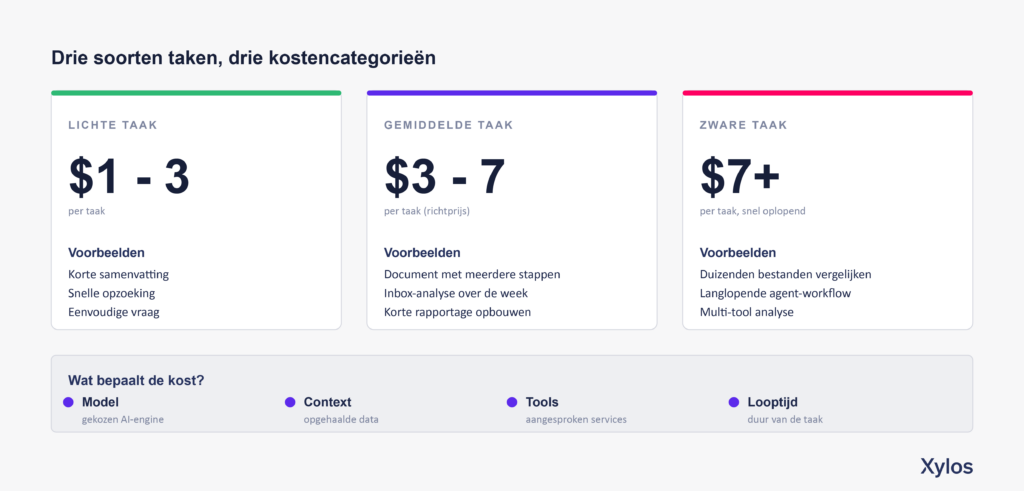
Variable AI costs are becoming mainstream
Cowork’s cost model is part of a broader trend. Uber recently imposed a limit of $1,500 per month per employee on AI usage. The internally developed practice of “tokenmaxxing” (burning as many tokens as possible, sometimes with internal leaderboards) clashes with the reality of token accounts. OpenAI is projected to have posted a loss of $38.5 billion in 2025, nearly eight times as much as the previous year. Anthropic put a planned price increase for its Claude Agent SDK on hold at the last minute. The pressure stems from price cuts by OpenAI and a planned initial public offering.
The message for Belgian organizations is that AI costs are becoming less predictable than those of a traditional software license. A well-thought-out approach keeps things manageable. Work in teams or by use case with a fixed AI budget, and monitor usage weekly. Evaluate quarterly whether the added value justifies the costs. Test more complex agent tasks on a small scale first before rolling them out more widely. Structured governance around AI budgets is now just as much a part of the digital workplace as the choice of software licenses itself.
Shadow AI and AI poisoning: two risks that reinforce each other
The European data protection authority warns against “shadow AI”: employees who use AI tools on their own initiative and thereby unintentionally leak company data. The problem is growing as consumer tools become more accessible and seem more convenient than the officially approved alternatives within the organization.
That same week, it emerged that ChatGPT was recommending fake stores in its shopping results that were targeting payment information. The cause is what researchers call “AI poisoning ”: malicious actors manipulate the sources that AI models use for training or searching, causing harmful results to appear in official responses.
Two risks that are interrelated. Shadow AI causes data to leave the organization uncontrolled, while AI poisoning causes unreliable answers to enter the organization. A practical solution combines technology and awareness. Establish clear AI guidelines that provide employees with guidance. Facilitate an officially supported AI platform so that the need for shadow tools is eliminated. And invest in an ongoing training program so that people know the limits of what they can entrust to an AI assistant. Our cybersecurity and learning teams often collaborate at that intersection.
AI in Education: Flanders Opts for a Roadmap
Norway recently became the first European country to largely ban generative AI from elementary schools. The concern is that children will skip crucial learning steps and fail to develop their critical thinking skills sufficiently. Flanders is taking a different approach. Minister Demir is 10 million euros for an AI roadmap for education. Responsible use and human oversight are central to this plan.
A decision with an impact beyond the school walls. Those entering the workforce in the coming years will bring with them the AI habits that are being formed in the classroom today. For organizations, this presents a twofold challenge. On the recruitment side, employers can support the Flemish initiative by collaborating with educational partners. Internally, AI literacy remains a core skill that must be maintained at every level of the organization. This aligns with what Tom and his colleagues at OASE and Xylos Learning are building every day. Learning programs that teach people to prompt, evaluate, and critically read, and that evolve alongside the new tools being introduced.
We will be back in two weeks with the next edition.
About Tom Van ‘t Veld
Tom has been working at Xylos for years, where he started as a Microsoft Office trainer and went on to become the driving force behind innovative learning concepts. He is one of the founders of OASE, Xylos’s online learning platform, and PlayForward, Xylos’s new gamified learning brand. He also developed, among other things, the Digital Coach concept, a Microsoft Teams Escape Room app, and the mAindset game which helps employees learn how to use AI prompts in a fun way. As a Learning Innovator, he has increasingly focused his attention in recent years on what AI means for the way we learn and work. Want to respond or continue the conversation? Find him on LinkedIn.