The basis remains the bi-weekly LinkedIn listing of Tom Van ‘t veld, Learning Innovator at OASE (powered by Xylos). Tom closely follows AI developments, and we translate his observations into what they concretely mean for organizations and the people working in them. Welcome to edition four.
ISSUE 5 • JUNE 8, 2026
On June 18, AI celebrates its 70th anniversary. On that date in 1956, the Dartmouth Summer Research Project on Artificial Intelligence began—the moment when the term “artificial intelligence” was first formally coined. What once began as a modest brainstorming session about chess programs is now writing its own codebase. Below are five stories from the past two weeks that will be most beneficial to your organization.
Microsoft Build 2026: Is the era of apps coming to an end?
Microsoft Build 2026 revolved around a central message from Satya Nadella: the era of apps and operating systems is over. Scout, the new always-on Copilot agent, autonomously monitors inboxes, calendars, and Teams sessions, even without the user asking a question. Project Solara outlines the next step, with a platform that runs AI agents instead of traditional applications, built on Android instead of Windows.
Real-world use calls for realism. Microsoft 365 Copilot received a speed boost and a revamped design. ZDNET tested the paid Copilot agents and found that while they came across as confident, they did not yet deliver the expected results for more complex tasks. The agent technology is clearly still maturing.
The vision is grand, but reliability remains the sticking point for now. For organizations, agents are now moving from pilot projects to everyday reality—and that reality is more chaotic than the keynote suggests. Choose use cases where an agent demonstrably saves time, and build in governance before the tools grow faster than your ability to control them.
New models prioritize honesty and safety
Anthropic launched Claude Opus 4.8, with honesty as its standout selling point. The model is about four times less likely to let errors in generated code slip by, and it indicates more often when it isn’t certain about something. However, complete trust is still out of the question, because the model can hallucinate with great confidence, and you only notice that when you check the output.
Security was a broader focus. OpenAI introduced Lockdown Mode for ChatGPT, an optional setting that disables web searches, Deep Research, and Agent Mode to protect against prompt injection, in which malicious instructions are hidden in web pages or uploaded files. Anthropic followed up with a free security plugin for the Claude Code terminal that detects vulnerabilities in codebases.
For those who work with sensitive information, the choice of which model to use for which use case is crucial. Models that dare to express uncertainty reduce risk, though they do not replace human oversight. Establish clear agreements regarding data and review so that the gains in speed are not lost in correcting errors.
Update following Tom’s overview: On June 9, Anthropic made Claude Fable 5 generally available—its most powerful public model to date—via the Claude API and Microsoft Foundry, among other channels. For sensitive domains such as cybersecurity, the model conservatively reverts to Claude Opus 4.8.
The AI bill is coming
The financial side of AI hit hard. On June 1, GitHub switched from a fixed monthly fee to token-based AI Credits. The base price per seat remains the same, but those who use agents intensively will see their costs rise sharply. The irony is striking: the very same companies that previously encouraged their employees to use AI as much as possible are now presenting the bill based on precisely that usage.
A few examples illustrate how the numbers can spiral out of control. An anonymous company accidentally spent $500 million on Claude in a single month after no one had set a usage limit on employee licenses. Microsoft revoked its own internal Claude Code licenses, and Uber had already used up its entire AI budget for 2026 by April. A Fortune article citing internal Microsoft research even states that, in a range of scenarios, AI tools cost more than human employees performing the same tasks. Gartner warns that falling token prices will not offset the rising consumption.
AI costs deserve the same level of discipline as any other IT expense. In a Microsoft 365 environment with a Premium Copilot license, this is less of an issue for now, but anyone who sets up pay-per-use agents for colleagues without a license will quickly run into the same surprises. Set usage limits, monitor consumption, and link each use case to an expected return on investment before scaling up.

The Counter-Movement and the Struggle for Visibility
The backlash against AI overkill is gaining momentum. The complete redesign of Firefox includes a button that lets you disable all AI features with a single click, and DuckDuckGo is making its AI-free search feature more prominent as its usage rises. Criticism of Google’s AI search mode is mounting: the search term is sometimes literally ignored, and the answers are increasingly sounding like advertisements. A study of 846,000 search queries confirms that AI Overviews significantly reduce click-through rates to source pages.
On the other hand, there is a growing focus on detection and transparency. YouTube will now automatically label AI-generated videos, Google’s SynthID watermarking technology is expanding to more formats, and Microsoft Clarity shows website owners which AI queries lead to their content.
For B2B organizations, search behavior is shifting—and with it, the way customers find you. AI models summarize what they read on your website, so valuable traffic is shifting. Invest in clear, authoritative content that holds up even in a summary, and start making arrangements today for labeling your own AI output.
Between the Pause Button and the IPO, and Why Literacy Is Winning
The AI labs showed their most contradictory side. Anthropic published a call for a global pause in the development of frontier AI, backed by its own figures: Meanwhile, Claude writes 80 percent of its own codebase. Four days later, the company confidentially filed its IPO prospectus. In the United States, Florida became the first state to sue OpenAI, naming Sam Altman personally as a co-defendant, while that same Altman is lobbying in Washington against requiring government approval for new models.
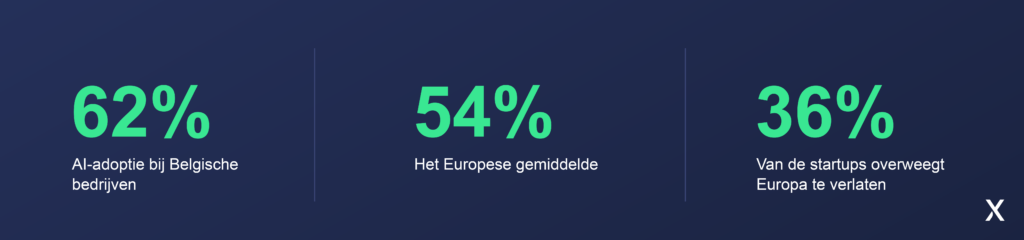
Meanwhile, Europe is trying to find its footing. The German organization SPRIND launched the Next Frontier AI competition, with 125 million euros in funding to build European frontier labs. An AWS study immediately highlights the Belgian paradox: with 62 percent AI adoption, our companies outperform the European average of 54 percent, while 36 percent of startups are considering leaving Europe due to a lack of venture capital. Good at getting started, not so good at staying the course.
Amid all this strategic fervor, a more measured perspective is emerging. Universities recognize that the use of AI has become the norm, while research shows that students who rely on AI as their primary teacher learn more superficially and develop less critical thinking skills. That same tension exists in every workplace where AI is introduced: the technology is scaling faster than the ability to evaluate its output.
The rules of the game surrounding AI will be written in the coming months, and your safest investment is in your own people. AI literacy is becoming a core skill at every level. That’s exactly where it overlaps with what Tom and his colleagues at OASE and Xylos Learning are building every day: literacy that scales along with the technology you adopt.
We will be back in two weeks with the next edition.
 About Tom Van ‘t veld
Tom has been working for Xylos for years, where he started as a Microsoft Office trainer and grew into the driving force behind innovative learning concepts. He is at the basis of OASE, Xylos’ online learning platform, and developed, among other things, the Digital Coach concept, a Microsoft Teams Escape Room app and the mAindset game that allows employees to playfully learn to promote AI. As a Learning Innovator, he has been increasingly focusing his gaze in recent years on what AI means for the way we learn and work. Respond or chat on? Find him at LinkedIn.